Introduction
The tech industry is buzzing — and the whispers all point in the same direction. Windows 13, the potential next major release from Microsoft, is shaping up to be one of the most transformative operating systems the company has ever shipped. Even as Microsoft keeps its cards close to its chest, the architecture of the future is already visible: it’s intelligent, it’s local, and it runs on AI at the chip level.
Whether Microsoft brands it “Windows 12” or skips ahead to 13, the fundamental shift is real. From Neural Processing Units (NPUs) that handle AI tasks on-device, to a Copilot assistant woven into every corner of the desktop, the next Windows isn’t just a new coat of paint. It represents a foundational rethinking of what a PC operating system should do — and who it should be smart enough to serve.
Table of Contents
In this deep-dive, we break down every credible feature, expected system requirement, gaming upgrade, and what all of this means for future Surface hardware. Read on for the most thorough analysis of the Microsoft AI OS on the web.
What Is Windows 13 — And Does It Exist?
Let’s address the elephant in the room directly. Windows 13 has not been officially announced by Microsoft. As of May 2026, the company is still shipping under the Windows 11 umbrella, with its 25H2 update expected in mid-2026 serving as a significant transition point. Industry analysts currently point to a potential “Windows 12” launch in late 2026 — though even that is unconfirmed.
So why are millions of people searching for “Windows 13”? Because the trajectory of Microsoft’s investments makes it clear that the next major Windows version — whatever it’s called — will behave like nothing we’ve seen before. The version name matters less than what it delivers. And the signals suggest it will deliver an AI-first operating system that fundamentally changes how people use a PC.
Microsoft’s direction is clear: AI is becoming the center of the Windows, Office, Surface, and enterprise ecosystem. — DigitaLicence, April 2026
The Naming Question
Microsoft has a history of unpredictable version naming — remember, they skipped Windows 9 entirely. Industry codenames like “Hudson Valley Next” have surfaced in manufacturer leaks as the internal name for the next major release. Some analysts believe Microsoft may simply continue evolving Windows 11 with enabling packages rather than launching a clearly numbered successor. Either way, what matters is the capability coming, not the badge on the box.
For clarity throughout this article, we use “Windows 13” to represent the next major generational leap in the Windows platform — the version that takes the Copilot+ architecture to its logical conclusion.
Windows 13’s Expected AI Features: The Microsoft AI OS Vision
Artificial intelligence isn’t an add-on in the next Windows — it’s the operating layer. Microsoft has spent the last two years embedding AI into Windows 11 at the hardware level via its Copilot+ PC standard, and the next major release is expected to deepen every one of those threads.
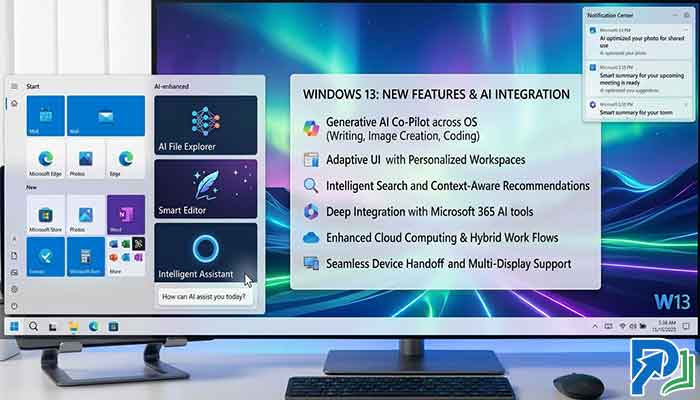
Here are the key AI features widely expected to define Windows 13 (or the next major Windows release):
What Makes This Different from Windows 11?
Windows 11 introduced the possibility of AI features on Copilot+ hardware. The next Windows is expected to make them unavoidable — and to extend them beyond the premium hardware tier. Microsoft’s stated goal is that AI experiences become as fundamental as File Explorer or the Start Menu. The difference is like comparing a car with optional GPS to one where navigation is built into the engine control system.
Importantly, the shift toward a subscription model for some advanced AI features has also been floated in industry reporting. This would mirror Microsoft 365 Copilot’s enterprise pricing approach — a significant consideration for consumers and IT decision-makers alike.
Windows 13 System Requirements: What Your PC Will Need
If Windows 11’s TPM 2.0 requirement caused controversy, the expected requirements for the next major Windows release will spark an even bigger conversation. AI at the hardware level means hardware specifications that older machines simply cannot meet.
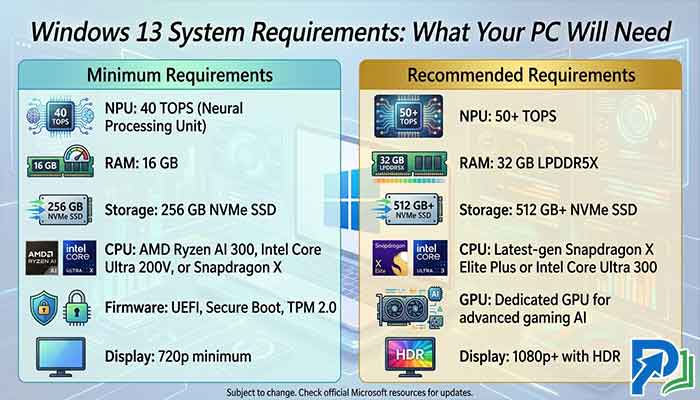
Based on Microsoft’s current Copilot+ PC standard and the direction of industry leaks, here are the projected Windows 13 system requirements:
Minimum Requirements
- NPU: 40 TOPS (Neural Processing Unit)
- RAM: 16 GB
- Storage: 256 GB NVMe SSD
- CPU: AMD Ryzen AI 300, Intel Core Ultra 200V, or Snapdragon X
- Firmware: UEFI, Secure Boot, TPM 2.0
- Display: 720p minimum
Recommended Requirements
- NPU: 50+ TOPS
- RAM: 32 GB LPDDR5X
- Storage: 512 GB+ NVMe SSD
- CPU: Latest-gen Snapdragon X Elite Plus or Intel Core Ultra 300
- GPU: Dedicated GPU for advanced gaming AI
- Display: 1080p+ with HDR
Key Insight: The 40 TOPS NPU requirement is not arbitrary. Running on-device AI models like Recall, real-time translation, and generative image tools demands that level of dedicated compute. Budget and legacy machines without a built-in NPU will be left behind — just as many older PCs were excluded from Windows 11.
Will Your Current PC Be Compatible?
If you bought a PC in 2022 or earlier, it almost certainly lacks the NPU required for full Windows 13 compatibility. PCs from 2024 onward with AMD Ryzen AI, Qualcomm Snapdragon X, or Intel Core Ultra 200-series chips stand the best chance. To check your current hardware, look for “Neural Processing Unit” in Device Manager under Windows 11 — its presence (or absence) is the clearest signal of your PC’s readiness.
Windows 13 vs. Windows 11: What Fundamentally Changes?
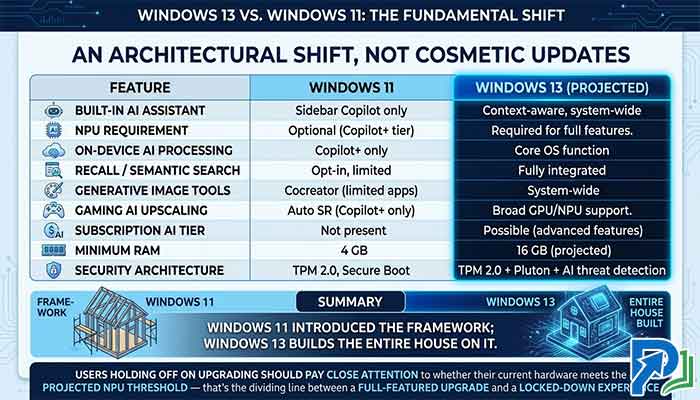
The differences between Windows 13 and Windows 11 aren’t cosmetic updates or incremental feature additions. They represent an architectural shift. Below is a direct comparison of where each platform stands.
| Feature | Windows 11 | Windows 13 (Projected) |
|---|---|---|
| Built-in AI Assistant | ⬤ Sidebar Copilot only | ⬤ Context-aware, system-wide |
| NPU Requirement | ⬤ Optional (Copilot+ tier) | ⬤ Required for full features |
| On-Device AI Processing | ⬤ Copilot+ only | ⬤ Core OS function |
| Recall / Semantic Search | ⬤ Opt-in, limited | ⬤ Fully integrated |
| Generative Image Tools | ⬤ Cocreator (limited apps) | ⬤ System-wide |
| Gaming AI Upscaling | ⬤ Auto SR (Copilot+ only) | ⬤ Broad GPU/NPU support |
| Subscription AI Tier | ⬤ Not present | ⬤ Possible (advanced features) |
| Minimum RAM | 4 GB | 16 GB (projected) |
| Security Architecture | TPM 2.0, Secure Boot | TPM 2.0 + Pluton + AI threat detection |
The summary: Windows 11 introduced the framework; Windows 13 builds the entire house on it. Users who have been holding off on upgrading should pay close attention to whether their current hardware meets the projected NPU threshold — that’s the dividing line between a full-featured upgrade and a locked-down experience.
PC Gaming on Windows 13: A New Era for Players
For gamers, the next Windows could represent the most significant platform shift since DirectX 12. Microsoft has been weaving AI into its gaming stack for years, and PC gaming on Windows 13 is expected to bring that work to full fruition.
Auto Super Resolution (Auto SR) and AI Upscaling
Already launched on Copilot+ PCs under Windows 11, Auto Super Resolution uses the NPU to upscale games in real time — boosting frame rates without sacrificing visual fidelity. Windows 13 is expected to expand this technology beyond the current Copilot+ hardware tier, potentially bringing AI upscaling to a much wider range of GPUs and APUs. Think NVIDIA DLSS, but at the operating system level — available by default, for every game.
AI-Assisted Gameplay Intelligence
Microsoft has already announced that Copilot AI will integrate into titles like Minecraft, offering in-game assistance, inventory search, and context-aware tips without breaking immersion. Windows 13 is expected to extend this to a broader catalog of Xbox PC Game Pass titles. Imagine an AI that reads the current state of your game and surfaces the right information — not a walkthrough, but a knowledgeable co-pilot.
DirectX and Driver Optimization
The next Windows is also rumored to include smarter driver management — using AI to detect compatibility issues, roll back problematic updates automatically, and optimize GPU scheduling based on real-time workload patterns. For competitive players, that means fewer crashes, lower latency, and more consistent frame times.
Bottom Line for Gamers: If you’re building or buying a gaming PC in late 2026 or beyond, prioritize a chip with a capable NPU alongside your GPU. The AI gaming features coming to Windows 13 will be NPU-dependent — and they’ll be significant.
The Future of Surface Laptops in the Windows 13 Era
Microsoft’s Surface lineup has always served as the “reference design” for Windows — the hardware that best demonstrates what the software is capable of. That relationship is only deepening. Surface laptops in the Windows 13 era are expected to be the first devices where every new AI feature works at full capacity out of the box.
Current Surface Copilot+ Lineup
The existing Surface Laptop (7th Edition) and Surface Pro (11th Edition) are already Copilot+ certified, featuring Snapdragon X Elite Plus processors with 45 TOPS NPUs, 16 GB of LPDDR5X RAM, and Microsoft Pluton security processors built into the silicon. These are essentially the bridge devices — hardware that will run Windows 13 natively when it launches, no upgrade required.
What’s Coming Next for Surface
Future Surface hardware is expected to push NPU performance significantly higher — above 60 TOPS — as Microsoft races to support more demanding on-device AI models. Rumors also point to:
- Tighter integration with Azure AI services for hybrid on-device/cloud processing
- Improved battery life driven by smarter power scheduling via the NPU
- A new Surface Studio variant designed specifically for AI-assisted creative workflows
- Modular Surface Pro designs that allow keyboard and connectivity upgrades without replacing the core device
Microsoft’s commitment to the Surface line as the showcase for Windows AI means these devices will always be the first to receive new features — making them a compelling choice for early adopters who want the full next-generation Windows experience.
Final Outlook: Should You Wait for Windows 13?
The honest answer depends entirely on your hardware. If your PC was built before 2023, waiting for Windows 13 is less about patience and more about planning your next upgrade cycle. The NPU requirement is real, and it’s not negotiable — AI processing at the operating system level demands dedicated silicon that simply doesn’t exist in older machines.
If you’re in the market for a new laptop or desktop in 2026, the advice is clear: buy for NPU capability first. Look for AMD Ryzen AI 300, Intel Core Ultra 200V, or Snapdragon X processors. These chips are already running the Copilot+ feature set that Windows 13 will build upon — meaning you’ll receive the full upgrade when it drops, at no extra cost.
For IT professionals and enterprises, the window between now and late 2026 is the time to audit your device fleet, identify NPU-capable machines, and plan a phased migration. Windows 10 support ended in October 2025. The clock is already ticking.
Windows 13 — in whatever form Microsoft ships it — isn’t just another version number. It’s the moment the PC becomes genuinely intelligent. Getting ready for it now is the smartest move you can make.
Frequently Asked Questions
Reference: