Introduction
The SpaceX Mars mission has never been closer to reality — or more complicated to predict. With Starship Version 3 completing its debut test flight on May 22, 2026, and Elon Musk still publicly targeting an uncrewed Mars landing window later this year, the space industry is watching every launch attempt with intense scrutiny. Whether you’re a space enthusiast, an investor, or just someone trying to make sense of the headlines, this guide breaks down everything that matters right now.
From the latest Starship launch schedule and NASA Artemis progress to how SpaceX stacks up against Blue Origin, this is your definitive 2026 update on humanity’s most ambitious engineering project.
Table of Contents
The Original SpaceX Mars Mission Plan for 2026
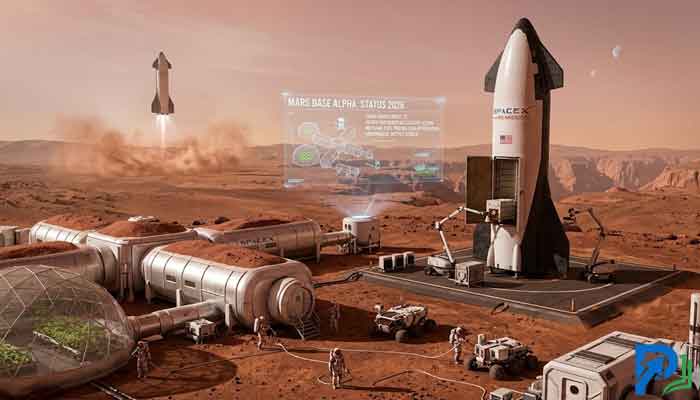
Back in September 2024, SpaceX made a landmark public announcement. The company declared it would launch the first uncrewed Starship missions to Mars during the 2026 Earth-Mars transfer window — a narrow orbital alignment that occurs roughly once every 26 months.
The original plan was specific:
- Five Starship vehicles would launch toward Mars
- Each vehicle would carry approximately 10 tons of payload
- All missions would be entirely uncrewed
- The primary goal: prove Starship can reliably land intact on the Martian surface
- If successful, crewed missions could follow as early as 2028
Elon Musk was direct: “Starship is going to Mars at the end of 2026.” For a while, that timeline felt real. The November–December 2026 launch window offers roughly a six-month transit time, making it the optimal departure point. Miss it, and the next window doesn’t arrive until early 2029.
Starship V3: The Rocket That Has to Get It Right
What Is Starship Version 3?
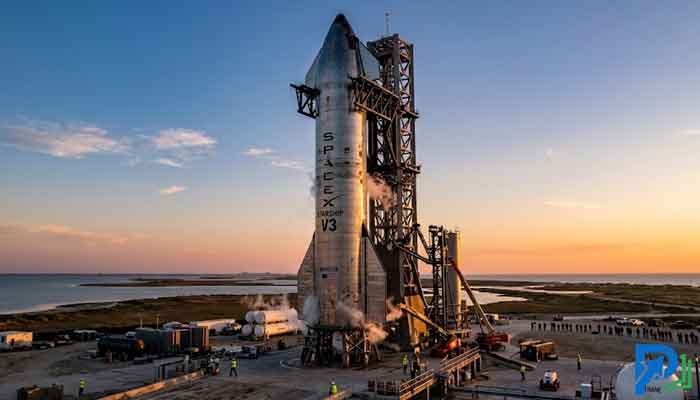
Starship Version 3 (V3) is the most significant upgrade in the program’s history. Standing 408 feet (124 meters) tall when fully stacked with its Super Heavy booster, it is the largest and most powerful rocket ever built.
Key upgrades over V2 include:
- Increased payload capacity — designed to carry significantly more mass to orbit
- Higher flight rate — structural and manufacturing improvements enable faster turnaround
- Upgraded Raptor engines — improved reliability and thrust efficiency
- New launch infrastructure — V3 debuted from the newly built Pad 2 at Starbase, Texas
SpaceX retired the V2 prototype after five test missions in 2025, which produced mixed results. Three flights ended in explosive failures early in the year before two successful landings in August and October stabilized the program heading into 2026.
Starship Flight 12: What Actually Happened
After three scrubbed launch attempts — first targeting March, then April, then May 21 — SpaceX successfully launched Starship V3 on May 22, 2026, from Pad 2 at its Starbase facility in South Texas.
Here’s what went right and what didn’t:
Successes:
- Ship 39 (the upper stage) reached its planned sub-orbital trajectory
- Successfully survived atmospheric reentry
- Deployed 22 dummy Starlink simulator satellites
- Completed the flight profile despite losing one of its six vacuum Raptor engines mid-flight — a significant demonstration of redundancy
- SpaceX formally declared most pre-planned test objectives as completed
Setbacks:
- The Super Heavy booster lost multiple engines during its boostback burn and came down in an uncontrolled hard landing in the Gulf of Mexico
- No tower catch was attempted on this first V3 flight — splashdown recovery was always the plan
Elon Musk called the result “epic.” The broader space community largely agreed that, despite the booster loss, Flight 12 represented a genuine programmatic pass. As one analysis framed it: Flight 12 proved V3 can fly, survive reentry, and deploy payloads under engine-out conditions.
The 2026 Mars Window: Is It Still Happening?
This is the question everyone is asking. The honest answer: it’s extremely uncertain.
In early 2026, the Wall Street Journal reported that SpaceX had communicated to investors that the company would “prioritize going to the Moon first” and attempt a Mars landing at a later time. That report suggested the 2026 uncrewed Mars landing had been effectively cancelled from an internal planning standpoint.
However, Musk has continued to publicly reaffirm the Mars goal. In a 42-minute presentation in May 2025, he laid out a vision to:
- Send uncrewed Starships to Mars in late 2026
- Carry Tesla’s Optimus humanoid robot as payload
- Follow with crewed missions in 2028 or 2029 if landings succeed
- Scale exponentially with each subsequent 26-month launch window
- Build toward a self-sustaining city of 1 million people by 2050
The critical problem is that as of late May 2026, Starship has never completed a full orbital flight, demonstrated in-orbit refueling, or conducted a deep-space mission of any kind. All test flights to date have been sub-orbital. For context, a Mars transit requires Starship to be fully refueled in orbit — a technically demanding operation that hasn’t been tested yet.
The November–December 2026 window is roughly six months away. That leaves SpaceX with a narrow runway to demonstrate orbital capability, test refueling, and prepare five vehicles for interplanetary launch. Most independent space analysts consider this timeline implausible, though few would bet against SpaceX surprising them.
NASA Artemis Progress and SpaceX’s Role
How Artemis Has Evolved
NASA’s Artemis program — the initiative to return humans to the Moon as a precursor to Mars — has undergone significant restructuring in 2026.
In February 2026, NASA officially revised the Artemis III architecture. The mission, originally planned to land two astronauts at the lunar south pole, will now remain in low Earth orbit and serve as a crewed rendezvous and docking test between the Orion spacecraft and two lander pathfinders:
- SpaceX’s Starship HLS pathfinder
- Blue Origin’s Blue Moon Mark 2 pathfinder
The actual Moon landing has been pushed to Artemis IV, now targeting a crewed lunar surface mission in 2028.
Why This Matters for Mars
The Starship Human Landing System (HLS) is a modified version of the V3 upper stage. This means Flight 12’s success — proving the base vehicle can fly reliably and survive reentry — is foundational to the entire Artemis timeline. SpaceX cannot realistically prepare a lunar lander for a 2027 docking test without first demonstrating that the core vehicle performs consistently.
NASA has made its position clear: it needs Starship to work. The agency has even floated the possibility of proceeding without SpaceX if deadlines aren’t met, given China’s stated goal of landing its own astronauts on the Moon by 2030.
SpaceX vs. Blue Origin: The Lunar Lander Race
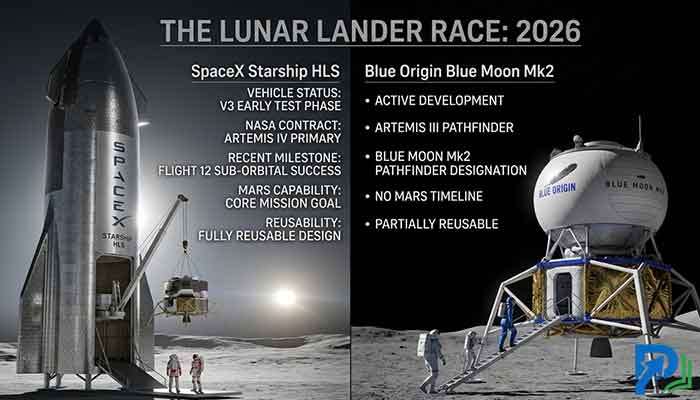
The competition to deliver NASA a reliable lunar lander has intensified dramatically in 2026. Here’s where both companies stand:
| Factor | SpaceX (Starship HLS) | Blue Origin (Blue Moon Mk2) |
|---|---|---|
| Vehicle Status | V3 in early test phase | Active development |
| NASA Contract | Artemis IV primary lander | Artemis III pathfinder |
| Recent Milestone | Flight 12 sub-orbital success | Blue Moon Mark 2 pathfinder designation |
| Mars Capability | Core mission goal | No Mars timeline |
| Reusability | Fully reusable design | Partially reusable |
Both companies have parallel NASA contracts for the Artemis III docking test, placing them in direct competition for credibility and future deep-space contracts. SpaceX’s advantage is its lead in iterative flight testing; Blue Origin’s advantage is that it has faced fewer high-profile failures.
For the commercial space travel market more broadly, both companies are racing to demonstrate that private spacecraft can reliably carry humans beyond low Earth orbit — a market worth potentially hundreds of billions of dollars annually.
Mars Colonization Tech: What SpaceX Is Building Toward
Beyond the rockets, SpaceX has been developing the broader technological stack needed to actually live on Mars. Key elements include:
Life Support and Habitat
- Pressurized habitats designed to be transported inside Starship’s payload bay
- In-situ resource utilization (ISRU) systems to produce oxygen and propellant from Martian CO₂ and water ice
Power Systems
- Solar arrays sized for Mars’ lower sunlight levels (~43% of Earth’s solar intensity)
- Nuclear power concepts for long-duration settlements in polar regions
Propellant Production
- Starship uses methane and liquid oxygen as propellants — both producible on Mars using the Sabatier reaction and water electrolysis
- This “fuel depot” strategy is essential for return trips and is a core part of SpaceX’s self-sustaining colony vision
Optimus Integration
- Musk has specifically named Tesla’s Optimus humanoid robot as the first “crew” on the 2026 uncrewed missions
- The robot would test autonomous operations in the Martian environment before human crews arrive
Read More: Windows 13: New Features and AI Integration
What’s Next: The Starship Launch Schedule for 2026
With Flight 12 complete, SpaceX is expected to accelerate V3 testing through the second half of 2026. Here’s what the roadmap looks like:
Near-term priorities (Summer 2026):
- Flight 13 and beyond — targeting full orbital insertion (a first for the program)
- Super Heavy booster recovery back at the “Mechazilla” tower catch system
- Demonstrate payload deployment from orbit
Medium-term (Fall 2026):
- Begin orbital refueling tests — critical for both Artemis and Mars
- Docking tests with Orion precursors
The Mars question:
- If the 2026 window is to be used, SpaceX would need to begin preparation of five Mars-bound Starships no later than August–September 2026
- No credible public evidence suggests this preparation is currently underway at scale
SpaceX’s IPO, currently targeting June 2026, adds a financial dimension: the company has a strong incentive to demonstrate ambitious progress to prospective public investors.
Key Takeaways: SpaceX Mars Mission in 2026
- Flight 12 is done. Starship V3 flew successfully on May 22, 2026, reaching space despite an engine anomaly. It’s a real milestone.
- Full orbit hasn’t happened yet. Every Starship flight to date has been sub-orbital. Orbital capability must come before Mars.
- The 2026 Mars window is in doubt. Internal SpaceX communications suggest Moon-first prioritization. Musk’s public statements maintain the goal.
- NASA Artemis is restructured. Artemis III now targets a docking test; the Moon landing moves to Artemis IV in 2028 — and Starship is essential to it.
- The technology foundation is real. Methalox propellants, ISRU planning, and habitat design represent genuine long-term Mars infrastructure.
Conclusion
The SpaceX Mars mission remains one of the most consequential engineering programs in human history — whether or not the 2026 uncrewed landing happens on schedule. Starship V3’s Flight 12 success demonstrates that the foundation is solidifying. But the gap between a successful sub-orbital test and five vehicles landing intact on another planet is vast, and the laws of orbital mechanics wait for no one.
What’s certain is that SpaceX is closer to Mars than any organization in history, and 2026 — even with its delays, pivots, and compressed timelines — is a year that will define the next decade of space exploration. Bookmark this page: we’ll be updating it with every significant development as the year unfolds.
Frequently Asked Questions
Sources: Space.com, CNN, Teslarati, SpacePolicyOnline, Futura Sciences, Wall Street Journal