Why Sustainable Laptops Matter in 2026
The sustainable laptop market has crossed a critical threshold. What was once a niche category populated by well-meaning but under-powered devices has become one of the most exciting segments in consumer electronics. In 2026, you no longer have to sacrifice performance to buy responsibly.
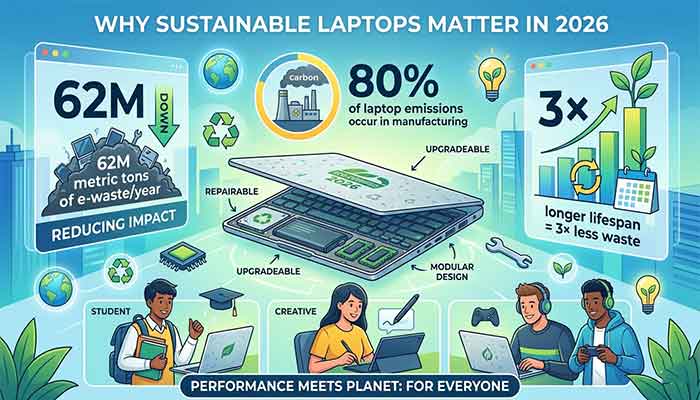
According to the Global E-Waste Monitor, the world generates approximately 62 million metric tons of electronic waste per year — and laptops are a significant contributor. Most traditional laptops are designed with planned obsolescence baked in: soldered RAM, glued batteries, and proprietary screws that make self-repair nearly impossible.
That’s changing fast. A new generation of manufacturers is proving that repairability, longevity, and raw performance can coexist. Whether you’re a student, a creative professional, or even a gamer, there’s now a genuinely great eco-conscious option for you.
62M
metric tons of e-
waste/year
80%
of laptop emissions
occur in
manufacturing
3×
longer lifespan =
3× less waste
Table of Contents
What Makes a Sustainable Laptop Truly Eco-Friendly?
The term “eco-friendly” gets thrown around loosely in marketing copy, but a genuinely sustainable laptop is evaluated across several measurable dimensions. Here’s the framework we use at Push-Wiki to assess every device on this list:
Repairability Score
Can a user replace the battery, RAM, or storage at home — without voiding the warranty? The best devices earn a 10/10 on iFixit’s Repairability Scale and even sell their own spare parts directly.
Material Sourcing & Recycled Content
Look for post-consumer recycled (PCR) plastics, ocean-bound plastics, recycled aluminum, and conflict-free minerals. Certifications like EPEAT Gold, TCO Certified, and RoHS compliance are strong indicators of responsible sourcing.
Carbon Footprint & Offsets
Manufacturing accounts for roughly 80% of a laptop’s lifetime carbon emissions. Brands that publish detailed Life Cycle Assessments (LCAs) and offer verified carbon offsets — or better yet, reduce emissions at the source — are leading the pack.
Longevity & Software Support
A laptop that receives OS and security updates for 7+ years is inherently more sustainable than one abandoned after 3. Longer software support cycles reduce the pressure to upgrade hardware unnecessarily.
Editor’s Note
We weight repairability and longevity most heavily in our ratings. A device made from recycled materials but impossible to fix after two years is still a disposable product — just with better PR.
Read More: Samsung S26 Ultra Review: Advanced AI Camera Test
Top 5 Sustainable Laptops of 2026
🥇 #1 Best Overall · Framework Laptop 16 (2026 Edition)
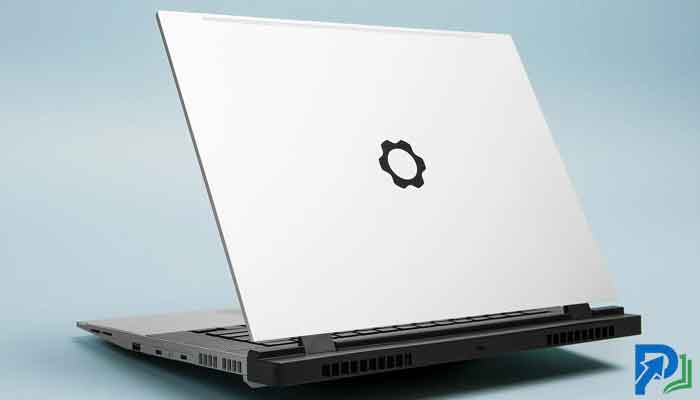
Modular · AMD Ryzen AI 9 · Starting at $1,149
Rating: ★★★★★ 5.0 / 5
IFixit 10/10 · EPEAT Gold · Carbon Offset · Modular GPU
Framework continues to set the gold standard for repairability. The 2026 edition adds an AI-enhanced Ryzen chip, an improved 165Hz display module, and a new Expansion Bay for swappable GPUs — all without a single proprietary screw.
✅ Pros
- Fully user-serviceable
- Best-in-class repairability
- Upgradeable RAM & storage
- Swappable port modules
- Transparent supply chain
⚠️ Cons
- Battery life (~10hrs) lags premium rivals
- Heavier than ultrabook competitors
- Higher upfront cost vs. disposable tier
Final Verdict
The Framework 16 is the most repairable, upgradeable, and philosophically honest laptop money can buy in 2026. If you care about e-waste and long-term value, this is the benchmark every other device is measured against.
🥈 #2 Best Premium · Dell XPS 13 Plus (2026)
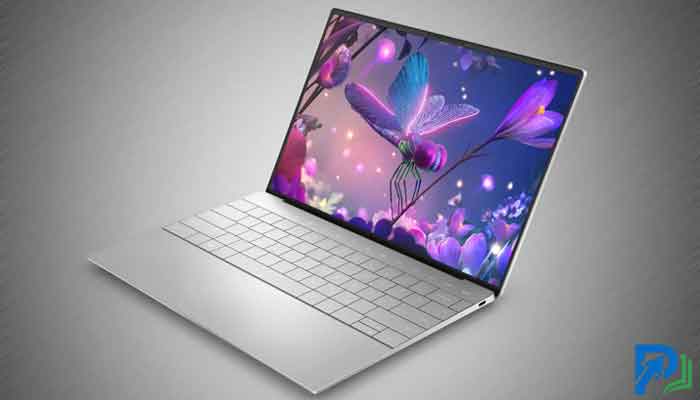
Carbon-Neutral Certified · Intel Core Ultra 9 · From $1,299
Rating: ★★★★½ 4.5 / 5
Carbon Neutral · 50% PCR Aluminum · EPEAT Gold · OLED Display
Dell’s 2026 XPS 13 Plus achieves full carbon neutrality across its lifecycle — a first for the XPS line. The chassis uses 50% post-consumer recycled aluminum and arrives in packaging made entirely from sustainably sourced materials.
✅ Pros
- Verified carbon-neutral lifecycle
- Stunning OLED display
- Premium build quality
- 14+ hr battery life
⚠️ Cons
- Limited repairability (iFixit 5/10)
- Soldered RAM
- Premium pricing
Final Verdict
If carbon-neutral manufacturing is your top priority and you need ultrabook elegance, the XPS 13 Plus delivers. Just know the repairability trade-off is real.
🥉 #3 Best for Business · Lenovo ThinkPad X1 Carbon Gen 13

Military-Grade · 90% Recycled Packaging · From $1,479
Rating: ★★★★½ 4.5 / 5
TCO Certified · EPEAT Gold · Recycled Fiber Body
Lenovo’s ThinkPad line has long been the corporate workhorse, and the Gen 13 adds meaningful green credentials: a chassis incorporating recycled carbon fiber and bio-based polymers, paired with Lenovo’s most aggressive CO₂ offset program to date.
✅ Pros
- Excellent keyboard
- Strong software support commitment (7 yrs)
- Mil-spec durability
- Serviceable SSD & battery
⚠️ Cons
- Soldered RAM
- Business-only aesthetics
- Complex BIOS ecosystem
#4 Best for Students · HP EliteBook 1040 G12
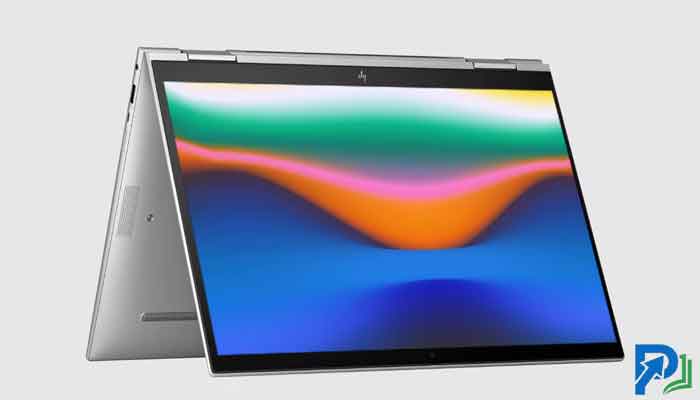
Ocean-Bound Plastic · 2-in-1 · From $999
Rating: ★★★★ 4.0 / 5
Ocean Plastic · EPEAT Silver · 2-in-1 Tablet Mode
HP uses ocean-bound plastics extensively in the G12’s chassis and keyboard housing, diverting over 50g of coastal plastic waste per unit. At under $1,000, it’s one of the most accessible eco-friendly options available, making it ideal for eco-conscious students.
✅ Pros
- Excellent value proposition
- Ocean plastic construction
- Versatile 2-in-1 form factor
- Strong student discounts available
⚠️ Cons
- Weaker GPU for creative tasks
- Display brightness (400 nits max)
- Average battery (9 hrs)
#5 Best Budget · Acer Aspire Vero 16 (2026)
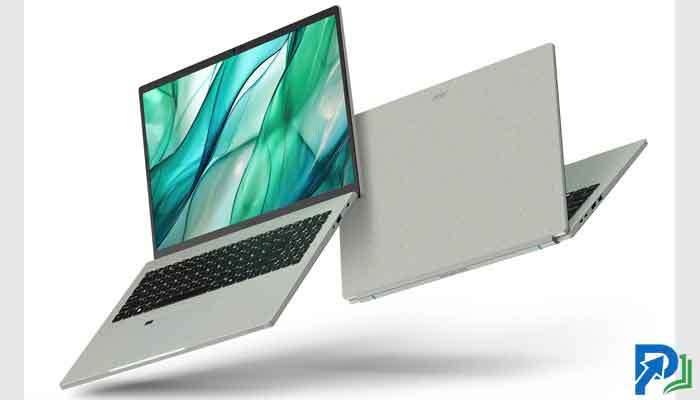
PCR Plastic · Budget-Friendly · From $699
Rating: ★★★★ 4.0 / 5
30% PCR Plastic · Recyclable Packaging
Acer’s Vero line remains the most affordable entry point into sustainable laptops. The 2026 model bumps the recycled plastic content to 30%, upgrades the display to a 16-inch WUXGA panel, and introduces a zero-cable unboxing experience using entirely recyclable pulp packaging.
✅ Pros
- Best price-to-green ratio
- Upgradeable RAM & SSD
- Large, comfortable display
⚠️ Cons
- Plastic build feels budget-tier
- No discrete GPU option
- Fan noise under load
Framework Laptop 2026 Review: The Sustainable Laptop Benchmark
Framework Computer has done something the tech industry insisted was impossible: built a modular, fully repairable laptop that’s also genuinely competitive on performance, display quality, and build feel. The 2026 Edition of the Framework 16 refines what was already the most important laptop of the decade.
Design & Build Quality
The CNC-machined aluminum chassis feels premium, not “eco-compromised.” Framework publishes the percentage of recycled content in each component — a level of material transparency that no major OEM matches. The keyboard modules, display bezels, and even the trackpad are user-swappable in under five minutes.
Performance in 2026
Equipped with AMD’s Ryzen AI 9 HX 390 processor and the optional Radeon RX 7700S Expansion Bay GPU, the Framework 16 handles 4K video editing, local AI model inference, and demanding workflows with ease. This is no longer a “good enough for what it is” machine — it’s just good.
Repairability: Still the Best in the Industry
Framework maintains its perfect 10/10 repairability score from iFixit. Every part — from the battery to the webcam module — is available for purchase through their marketplace. This directly translates to less e-waste and lower total cost of ownership over time.
Real-World Impact
Framework reports that over 60% of their existing customers have upgraded at least one component rather than replacing the entire device. Each upgrade extends the hardware’s useful life by an average of 2.3 years — that’s a measurable climate impact, not a marketing claim.
Carbon-Neutral Laptops: Who’s Leading the Charge?
Carbon neutrality in consumer electronics is a contested claim. Some companies achieve it through purchased offsets alone — a practice increasingly viewed as inadequate. Others are investing in genuine supply-chain emissions reductions. Here’s where the major players stand in 2026:
- Dell: Full lifecycle carbon neutrality on XPS and Latitude lines, backed by Science-Based Targets initiative (SBTi) verification.
- Apple: Claims carbon neutrality for Apple Watch and some accessory products; MacBook carbon neutrality is projected for 2030 under their roadmap.
- Lenovo: Has committed to net-zero emissions by 2050 with interim 50% reduction targets by 2030; currently achieves carbon neutrality on select ThinkPad SKUs via offsets.
- Framework: Does not yet claim carbon neutrality but publishes a full LCA with verified third-party data, and argues that repairability achieves greater real-world impact than offset purchasing.
- HP: Carbon-neutral certification on EliteBook 600-series and above; one of the earliest to achieve EPEAT Gold Climate+ on laptop products.
The most important nuance: scope matters. A laptop that claims carbon neutrality only for Scope 1 and 2 emissions (direct and energy-related) while ignoring Scope 3 (supply chain, manufacturing, end-of-life) is presenting a misleadingly partial picture. Always look for the full LCA documentation.
Best Repairable Laptops for Students in 2026
Students face a unique sustainability calculus: tight budgets, high wear-and-tear, and 4+ years of heavy use ahead. A repairable laptop is especially valuable in this context — a cracked screen or failing battery shouldn’t mean a $900 replacement purchase.
What Students Should Prioritize
- Repairability score of 7/10 or higher — ensures you can replace key components yourself or at a local shop.
- Available spare parts marketplace — Framework’s Marketplace, Lenovo’s Parts Lookup, and HP’s Parts Surfer are the gold standard.
- 5–7 year OS support commitment — avoids forced upgrades mid-degree.
- Sub-$1,000 entry price — Framework 13 and Acer Vero 16 both qualify.
- MIL-SPEC durability ratings — critical for laptop bags, lecture halls, and campus life.
Our pick for students: The Framework Laptop 13 remains the best repairable laptop for students. It starts at $849, accepts community-designed modules, and Framework’s educational pricing makes it even more competitive. Pair it with a 2TB SSD upgrade two years in instead of buying a new machine.
Eco-Friendly Gaming: Can Sustainable and High-Performance Coexist?
Gaming laptops have historically been the least eco-friendly category: power-hungry GPUs, disposable thermal paste designs, and two-year upgrade cycles driven more by marketing than necessity. In 2026, that’s starting to shift.
Framework 16 + Expansion Bay GPU
The Framework 16 is the first mainstream gaming-adjacent laptop where the GPU is user-replaceable. When AMD or NVIDIA releases a new Expansion Bay module, you upgrade the GPU — not the whole machine. This is a fundamental rethinking of how gaming laptops should work.
ASUS ROG Zephyrus G16 (2026) — Eco Edition
ASUS launched a limited “Eco Edition” of the Zephyrus G16 in early 2026, featuring a recycled aluminum lid, reduced-scope carbon offset certification, and packaging made from mushroom-based materials. Performance is identical to the standard model (RTX 5070, 240Hz QHD display). It’s a meaningful step, even if internal repairability (iFixit 4/10) lags behind Framework.
Bottom line: Eco-friendly gaming is no longer an oxymoron, but repairability in the gaming segment still lags the broader market. The Framework 16 remains the only true eco-first gaming-adjacent option in 2026.
Solar Laptop Technology in 2026: Real or Gimmick?
The idea of a solar-powered laptop has existed for decades, usually as a concept device or a disappointing prototype. In 2026, solar charging is finally becoming a practical — if niche — supplementary technology for laptops.
How Solar Laptop Charging Works Today
No laptop in 2026 charges exclusively from a built-in solar panel — physics doesn’t cooperate at current panel efficiencies. Instead, solar integration takes two practical forms:
- Solar panel accessories: Portable foldable panels (like the Anker 625 Solar Panel or Goal Zero Nomad 20) that charge via USB-C PD at 20–65W. Effective in direct sunlight; complements — not replaces — grid charging.
- Solar-assisted keyboards and lids: A handful of concept and niche devices (notably from Kyocera and a Taiwanese startup called SolarBook) embed thin-film photovoltaic cells in the lid. In strong outdoor light, these extend battery life by 20–35% — not full charging, but meaningful range extension for outdoor workers.
What to Expect by 2028
Perovskite solar cells — thinner, more flexible, and up to 33% efficient in lab conditions — are approaching commercial viability. Several laptop manufacturers have filed patents for perovskite-integrated display backs. Mainstream solar-assisted laptops capable of 50%+ range extension in sunlight are a realistic near-term development, not science fiction.
For now, if solar charging matters to your workflow, invest in a high-efficiency portable panel rather than waiting for integrated solar to mature. Pair it with a USB-C charging laptop rated at 65W or below for best results.
Quick Comparison: Best Sustainable Laptops 2026
| Laptop | iFixit Score | Carbon Neutral | PCR Materials | Battery Life | Starting Price |
|---|---|---|---|---|---|
| Framework 16 (2026) | 10/10 | Offset only | ✓ | ~10 hrs | $1,149 |
| Dell XPS 13 Plus (2026) | 5/10 | ✓ Certified | ✓ 50% Al | ~14 hrs | $1,299 |
| ThinkPad X1 Carbon Gen 13 | 7/10 | Select SKUs | ✓ | ~13 hrs | $1,479 |
| HP EliteBook 1040 G12 | 6/10 | EPEAT Silver | ✓ Ocean Plastic | ~9 hrs | $999 |
| Acer Aspire Vero 16 | 8/10 | No | ✓ 30% PCR | ~11 hrs | $699 |
Sustainable Laptop Buying Guide: 5 Questions to Ask Before You Buy
Not every buyer has the same priorities. Use these five questions to match a sustainable laptop to your specific situation:
- How long do I plan to keep this laptop?
If 5+ years, repairability is your most important metric. Choose Framework or ThinkPad. If 2–3 years, carbon-neutral manufacturing may rank higher. - Do I have the skills (or access to repair services) to use a repairable device?
Framework’s repair guides are excellent for beginners, but if you’re not comfortable with a screwdriver, a device with a good repair ecosystem (Lenovo, HP) and nearby authorized service centers may serve you better. - Is the manufacturer’s sustainability claim third-party verified?
Look for EPEAT Gold, TCO Certified 9, or SBTi verification. Self-reported claims without independent auditing are worth less. - What’s the total cost of ownership?
A $1,149 Framework that you upgrade over 7 years often costs less than two $799 disposable laptops over the same period — and generates far less waste. - Does the brand support right-to-repair legislation?
Framework and System76 actively advocate for right-to-repair laws. Other brands have lobbied against them while marketing “green” credentials — a significant red flag.
Pro Tip: Check the manufacturer’s sustainability report — not the product page. Annual reports filed with frameworks like CDP (Carbon Disclosure Project) or GRI (Global Reporting Initiative) are far more reliable than headline marketing claims.
Conclusion: The Future of Sustainable Laptops Is Now
The sustainable laptop landscape in 2026 is genuinely exciting — not because the industry has solved every problem, but because the pace of progress has become undeniable. Repairability scores are rising. Carbon-neutral certifications are being verified rather than just claimed. Solar tech is approaching practical viability. And consumers are demanding better.
Our top recommendation remains the Framework Laptop 16 for those who prioritize repairability and long-term value above all else. For users who need ultrabook elegance with verified carbon neutrality, the Dell XPS 13 Plus is a credible alternative. Budget buyers and students will find the Acer Vero 16 and HP EliteBook 1040 compelling options that don’t ask for a premium to be responsible.
Ultimately, the best sustainable laptop is the one you keep the longest. Buy well, upgrade deliberately, and resist the annual upgrade cycle — that single behavior change reduces your personal tech footprint more than any certification label ever could.
Have questions about a specific sustainable laptop not covered here? Drop a comment below or reach out to the Push-Wiki editorial team. We update this guide quarterly with new releases and independently verified data.
Frequently Asked Questions
References:
Global E-Waste Monitor 2024 — globalewaste.org
iFixit Repairability Scores — ifixit.com/laptop-repairability