I was scrolling through a random Discord server last month — one of those AI art communities I lurk in for work — when someone casually dropped a link to a “face swap” tool. Within two clicks, I watched a total stranger’s photo get turned into something they never agreed to. No consent. No warning. Just… there.
That’s the moment AI porn stopped being an abstract headline for me and became something I actually had to sit with.
I’ve spent years testing AI tools professionally — image generators, chatbots, voice clones, all of it. So when people ask me “is AI porn harmful?” I don’t answer with a knee-jerk yes or no. I answer with what I’ve actually seen. And honestly? The dangers of AI porn go way deeper than most articles let on. This isn’t just about awkward internet content anymore — it’s about consent, mental health, and a legal system that’s sprinting to catch up with technology that’s already three steps ahead.
Let’s get into it.
Personal Experience with AI Porn Tools
A few months back, I decided to actually test one of these “undressing” apps that kept popping up in my ad feed — purely from an analyst’s perspective, to understand how the tech worked and what safeguards (if any) existed.
I uploaded a stock photo of a fully clothed model, just to see the output. No real person, nothing malicious on my end. What shocked me wasn’t the image quality — it was how little the app cared about verifying consent. There was no ID check, no “is this you?” prompt, nothing. Just an upload button and a payment wall.
That’s when it hit me: if I could do this with a stock photo in under two minutes, anyone could do this with a photo of an ex, a coworker, or a classmate pulled straight off Instagram.
I closed the app and honestly felt a little sick. Not because the tech was impressive — it was — but because I realized how completely unprotected regular people are from this. I’ve tested a lot of AI tools that made me go “wow, cool.” This was the first one that made me go “we have a real problem here.”
That experience changed how I write about AI. I stopped treating “AI porn” as a niche internet topic and started treating it as a genuine digital safety issue.
Read More: 3D design tools Powered by AI for the Metaverse
What Exactly Is AI Porn, And Why Is It Exploding Right Now?
AI porn generally falls into two buckets:
- Fully synthetic content — AI-generated images or videos of people who don’t exist at all
- Non-consensual deepfakes — real people’s faces or bodies manipulated into explicit content without their permission
The second category is where things get genuinely scary, and it’s growing fast because the barrier to entry basically doesn’t exist anymore. You don’t need coding skills. You don’t need expensive software. You need a photo and a free weekend.
The Real Dangers Of AI Porn
Here’s where I want to slow down, because this is the part most listicles skip past.
Non-Consensual Deepfakes Are the Biggest Risk
This is, hands down, the scariest piece of the AI porn conversation. Anyone with a public photo — a LinkedIn headshot, a prom picture, a random selfie — can become the subject of explicit content they never agreed to. Teenagers have already been targeted at school using nothing more than yearbook photos. That’s not a hypothetical. It’s happened, and it’s been reported on by multiple news outlets.
Mental Health Effects Of AI Porn
I’m not a therapist, so I won’t pretend to diagnose anyone. But from what I’ve read and from conversations I’ve had with people in tech-ethics circles, a few patterns keep coming up:
- Victims of deepfake harassment report anxiety, shame, and a loss of trust in online spaces
- Heavy AI porn consumers sometimes describe distorted expectations around intimacy and real relationships
- The “always available, infinitely customizable” nature of AI porn can reinforce compulsive usage patterns for some people
If any of this sounds like something you’re personally dealing with, that’s genuinely worth talking through with a therapist or counselor — not something to just push down.
Privacy And Blackmail Risks
This one doesn’t get talked about enough. Fake explicit images are increasingly being used for sextortion — criminals generate a fake nude, then threaten to send it to your family or employer unless you pay up. The FBI has issued public warnings about this exact scam. The scary part? The image doesn’t even need to be real for the threat to work. Just convincing.
Is AI Porn Harmful? Breaking Down the Bigger Picture
Short answer: yes, in specific and serious ways — but it’s not one-size-fits-all harm. The risk really splits into two lanes:
- Harm to the people depicted (consent violations, reputational damage, blackmail)
- Harm to the people consuming it (mental health strain, unrealistic expectations, compulsive use)
Does one matter more than the other? Honestly, I don’t think it’s a competition. Both deserve attention, and most current laws only address one of them — usually poorly.
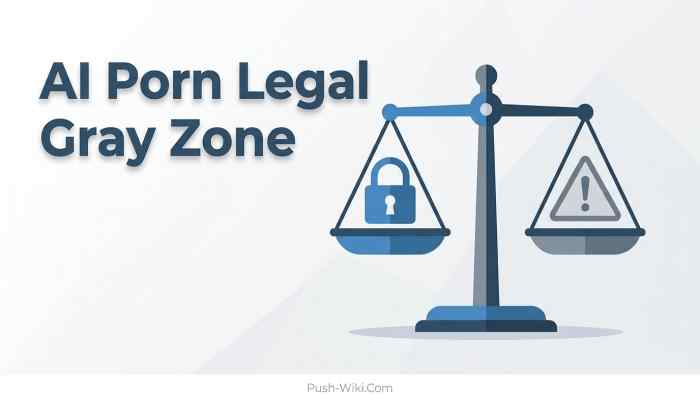
AI Generated Nudes Risks: The Legal Gray Zone
Here’s something that genuinely frustrated me while researching this: laws vary wildly depending on where you live. Some U.S. states have passed specific deepfake laws. Others haven’t touched the issue at all. And enforcement? Even messier, since a lot of these tools and sites operate overseas, completely outside local jurisdiction.
If you’ve ever wondered why it feels like nobody’s really “in charge” of stopping this — that’s because, legally speaking, nobody fully is yet.
Traditional Porn vs. AI Porn: A Quick Risk Comparison
| Risk Factor | Traditional Porn | AI Porn |
|---|---|---|
| Consent of people shown | Generally consensual (licensed platforms) | Often zero consent (deepfakes) |
| Ease of creation | Requires production, equipment, people | One photo + an app |
| Traceability | Studio/platform accountable | Often anonymous, hard to trace |
| Blackmail/sextortion risk | Lower | Significantly higher |
| Legal clarity | Established regulations | Patchy, inconsistent, evolving |
How to Protect Yourself From AI Porn Risks
A few practical things I now do myself:
- Limit public photos on social media, especially high-res face shots
- Set up Google Alerts for your name to catch anything unusual early
- Report deepfake content immediately to the platform — most now have dedicated takedown forms
- If you’re targeted, document everything before reporting; screenshots matter for law enforcement
FAQ: What People Are Actually Asking About AI Porn
Wrapping This Up
Look, I’m not here to tell you AI is evil — I use it every single day, and plenty of it genuinely makes my life easier. But AI porn is one corner of this technology where I think we’re moving faster than we’re thinking. The tools got powerful before the guardrails did, and real people are paying the price for that gap.
Martin’s Final Tip: Treat every photo you post online as something that could technically end up somewhere you never intended. That’s not paranoia — it’s just where the tech is right now.
Have you run into anything like this yourself, or seen it happen to someone you know? I’d genuinely like to hear about it — drop a comment and let’s talk it through.