Introduction
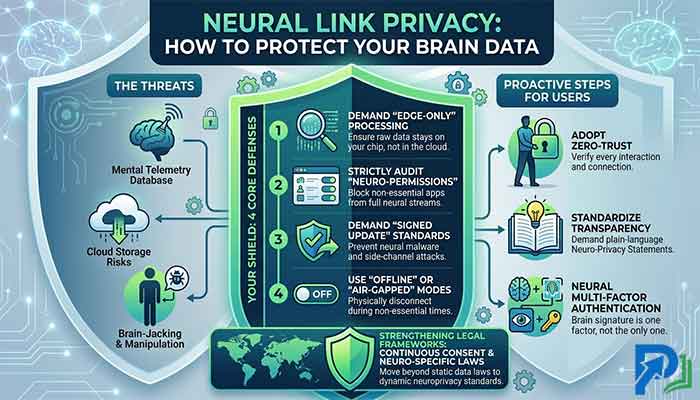
Neural link privacy is no longer a sci-fi concept — it’s a present-day concern that millions of people will face within this decade. As brain-computer interfaces (BCIs) move from research labs into consumer products, the data they generate is among the most sensitive information ever produced by a human being. Your thoughts, cognitive patterns, emotional states, and neurological responses are now on the table — and so are the companies that want to harvest them.
This guide walks you through exactly how to protect your brain-computer data, configure your BCI privacy settings, and stay ahead of an industry that is evolving faster than the laws designed to regulate it.
Table of Contents
What Is Neural Link Privacy — and Why Does It Matter?
Neural link privacy refers to your right to control, protect, and limit access to the neurological data generated by BCIs, neural wearables, and implanted devices. Unlike your browsing history or purchase behavior, this data reflects the biological architecture of your mind.
Here’s why it’s uniquely dangerous in the wrong hands:
- Thought inference: Algorithms can predict emotional states, intentions, and even unspoken words from raw neural signals.
- Identity fingerprinting: Your brainwave patterns are as unique as your fingerprints — and far harder to change if compromised.
- Behavioral manipulation: Bad actors with access to neural data can craft hyper-personalized influence campaigns targeting your cognitive vulnerabilities.
- Medical profiling: Neurological data can reveal conditions like epilepsy, depression, or cognitive decline — long before a clinical diagnosis.
The stakes are high. Understanding the threat landscape is the first step to protecting yourself.
How Neural Data Gets Harvested
Before you can secure your neural link, you need to understand the attack surface. Data harvesting in the BCI space occurs at multiple points:
1. Device-Level Collection
Most consumer neural wearables and BCIs collect raw or processed EEG/EMG/fNIRS data continuously. This data is often stored on the device itself before being synced to cloud servers. Manufacturers may retain this data indefinitely under vague “research improvement” clauses buried in terms of service.
2. Cloud Synchronization and Storage
When your neural device syncs to an app or cloud platform, your data traverses multiple servers — often across jurisdictions with different privacy laws. Encryption in transit is becoming standard, but encryption at rest remains inconsistently applied.
3. Third-Party Data Sharing
Most neural device apps include third-party SDKs for analytics, advertising, or health integrations. These SDKs can access sensor data in the background, package it, and send it to data brokers without your meaningful consent.
4. Firmware and Software Vulnerabilities
Like any connected device, BCIs are susceptible to exploitation. A compromised firmware update or a man-in-the-middle attack on an unencrypted Bluetooth connection can expose your neural data stream in real time.
How to Protect Your Neural Link Privacy: Step-by-Step
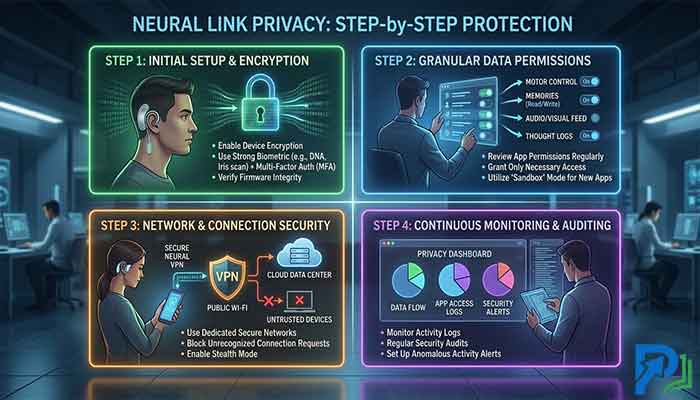
This is a how-to guide, so let’s get specific. Follow these steps to harden your neural link security posture today.
Step 1: Audit Your Device’s Data Collection Permissions
Before you put any BCI device on your body, review its data practices:
- Navigate to the device’s companion app settings.
- Locate the Privacy or Data Sharing section.
- Disable all optional data collection — telemetry, usage analytics, and third-party sharing.
- Opt out of research programs unless you have reviewed the consent form in full.
- Check whether the manufacturer offers a “local-only” mode that prevents cloud uploads.
Pro tip: If a device does not offer granular BCI privacy settings, treat that as a red flag. Reputable manufacturers will give you meaningful control.
Step 2: Harden Your BCI Privacy Settings at the OS Level
Your smartphone or tablet is the primary gateway between your neural device and the internet. Lock it down:
- Revoke unnecessary app permissions. Your BCI app should not need access to your contacts, location, or microphone.
- Enable app sandboxing. On iOS, this is largely automatic. On Android, use a privacy-focused launcher or a device with strong sandboxing (e.g., GrapheneOS).
- Disable background app refresh for your BCI companion app when not actively using it.
- Use a VPN with a no-logs policy when syncing neural data to cloud platforms.
- Enable two-factor authentication (2FA) on every account associated with your neural device.
Step 3: Evaluate the Manufacturer’s Privacy Policy
This step is non-negotiable. A privacy policy is a legal document — read it like one. Look for:
- Data retention periods: How long is your neural data kept? Indefinite retention is a major risk.
- Third-party disclosures: Does the company sell or license your data? To whom?
- Deletion rights: Can you request full deletion of your data upon account closure?
- Breach notification policy: Will you be notified promptly if your data is exposed?
- Jurisdiction: Where is the company incorporated? Are they subject to GDPR, HIPAA, or CCPA?
If the policy is vague, contact their support team in writing and request clarification. Document their response.
Step 4: Secure the Wireless Connection on Wearable Sensors
Securing wearable sensors starts with the wireless protocols they use — most commonly Bluetooth Low Energy (BLE). Here’s how to reduce exposure:
- Keep firmware updated. Manufacturers patch BLE vulnerabilities regularly; outdated firmware is low-hanging fruit for attackers.
- Pair devices in a private environment. Never pair a BCI device on a public Wi-Fi network or in a high-density Bluetooth environment.
- Disable discoverability on your device when not actively pairing.
- Use devices that implement BLE pairing with encryption (look for “LE Secure Connections” in product specs).
- Audit paired devices regularly. Remove any unrecognized entries from your Bluetooth device list.
Step 5: Demand Transparency Through Regulatory Channels
Individual action matters — but so does systemic change. Here’s how to push for stronger protecting brain-computer data regulations:
- File complaints with the FTC if a neural device manufacturer misrepresents its data practices.
- Support neuro-rights legislation. Several U.S. states, including Colorado and California, are advancing bills that classify neural data as a protected category.
- Engage with organizations like the Neurorights Foundation, which advocates globally for legal protections around brain data.
- Participate in public comment periods when the FDA or FTC proposes new rules on BCI devices.
The Future of Neuro-Privacy: What’s Coming Next

The future of neuro-privacy is being written right now, and the trajectory is alarming without intervention. Here’s what researchers and regulators are tracking:
Passive Thought Capture
Emerging BCIs no longer require active user engagement to collect meaningful data. Passive, always-on devices worn as headbands, earbuds, or AR glasses can log neural correlates of attention, stress, and emotion throughout the day — without the user ever “using” the device consciously.
Neural Data as an Asset Class
Venture capital is flowing heavily into neurotechnology. The business model that emerges may closely mirror social media: the product is free, and the neural data is monetized. Several startups are already pitching neural data licensing to advertisers and insurance companies.
AI-Powered Neural Decoding
Large language models fine-tuned on neural datasets are dramatically improving the accuracy of thought-to-text and intention-detection systems. What once required invasive implants can increasingly be inferred from non-invasive wearables. This dramatically expands the threat surface for neural link security.
Emerging Legal Frameworks
Chile became the first country in the world to enshrine neurorights in its constitution in 2021. The EU is drafting BCI-specific provisions under its AI Act. In the U.S., the Neurorights Act has been introduced in Congress — though passage remains uncertain as of 2025.
Staying informed on these developments is not optional for anyone who owns or plans to own a neural-linked device.
Neural Link Security: Technical Safeguards for Power Users
If you’re a technically sophisticated user or working within an organization deploying BCI technology, these additional measures are worth implementing:
- Network-level monitoring: Use a home firewall (e.g., Pi-hole + pfSense) to log all outbound traffic from your BCI device. Any unexpected server communication should be investigated.
- Data minimization at the edge: Where devices allow it, configure them to process data locally and transmit only aggregate or anonymized outputs.
- Differential privacy: For organizations, implement differential privacy techniques when aggregating neural data across users to prevent re-identification.
- Zero-trust architecture: Treat every BCI device as an untrusted endpoint. Do not grant it access to internal networks or sensitive systems without strict access controls.
- Red team your setup: Periodically test your configuration against known BLE attack vectors using tools like Wireshark or BtleJuice (in a controlled, legal environment).
Comparing BCI Privacy Approaches by Device Category
| Device Type | Data Sensitivity | Default Privacy Risk | Key Mitigation |
|---|---|---|---|
| Consumer EEG headsets | Medium | High (cloud-first design) | Local-only mode, app permissions |
| Medical-grade implants | Very High | Moderate (regulated) | HIPAA compliance, audit trails |
| AR/VR neural overlays | High | Very High (always-on sensors) | Firmware review, network isolation |
| Research-grade BCIs | High | Low (IRB oversight) | Consent documentation, data minimization |
| Gaming neural controllers | Low–Medium | Medium | Third-party SDK audit |
Conclusion
Neural link privacy is not a future problem — it’s a present one. As BCIs transition from clinical tools to consumer products, the data they generate will become one of the most valuable and most vulnerable assets you own. The steps outlined in this guide — auditing BCI privacy settings, securing wearable sensors, scrutinizing data policies, and engaging with emerging regulations — give you a concrete framework to protect yourself today.
The future of neuro-privacy depends on informed users who refuse to treat their brain data as just another terms-of-service checkbox. Take control now, before the industry defaults are set on someone else’s terms.
Frequently Asked Questions (FAQs)
References
- Neurorights Foundation — Global advocacy for brain data legal protections
- FTC Consumer Information on IoT Security — Official guidance on connected device data rights